Officially Cancelled: PT KAI Halts 23 Used EMU Imports, Mandates 23 New Trainsets via PT INKA Flexible Production
Following a high-level limited cabinet meeting with President Prabowo Subianto on 5 November 2026, PT Kereta Api Indonesia (Persero) has officially cancelled its planned import of 23 second-hand Electric Multiple Unit (EMU) trainsets from Japan, replacing it with an accelerated procurement mandate for 23 brand-new trainsets targeted for completion within 2–3 years (2028–2029). Managed through national rolling stock manufacturer PT INKA (Persero) via a flexible production scheme, this landmark move aims to counter surging daily commuter ridership while mitigating the safety risks of retiring 92 aging commuter trainsets across Greater Jakarta.
Executive Summary: A Decisive Paradigm Shift in National Commuter Rolling Stock
The decision to cancel the import of 23 used Japanese commuter trainsets on 5 November 2026 marks a watershed moment in the history of Indonesian urban rail transit. After nearly two decades of reliance on second-hand rolling stock imported from Tokyo metropolitan operators such as JR East and Tokyo Metro, the Government of Indonesia under President Prabowo Subianto has firmly established an uncompromising doctrine: public transit services for the people must utilize modern, reliable, and brand-new trains.
This policy intervention directly addresses an escalating capacity crisis in Greater Jakarta (Jabodetabek). Commuter passenger demand throughout 2026 surged by 11.5% year-on-year (YoY), far exceeding initial projections of 3% to 4%. Concurrently, out of 102 active trainsets available at the beginning of 2026, 13 sets had to be permanently retired due to technical degradation, against a mandatory timetable requirement of 105 daily operational sets.
To execute this major transition without disrupting the daily journeys of 1.1 million commuters, PT KAI President Director Bobby Rasyidin on 6 November 2026 introduced the Flexible Production Scheme. State-owned rolling stock builder PT Industri Kereta Api (Persero), or INKA, has been designated as the sole procurement gateway. Given that INKA's current actual assembly capacity at its Madiun plant stands at 2 to 3 trainsets annually, INKA has been granted full authorization to partner with top-tier international manufacturers (via co-production or joint ventures), under the strict condition that all partnerships mandate local industry participation and technology transfer.
CHART 1: EXISTING EMU PROCUREMENT REALIZATION & MANDATE STRUCTURE
Breakdown of 27 New Trainsets + 2 Retrofits vs 23 New Trainsets Mandate (2024-2029)
1. Policy Chronology: From Parliamentary Proposals to the Presidential Palace Mandate
The policymaking surrounding commuter rolling stock procurement underwent a rapid and decisive shift within a six-week window between late September and early November 2026. This evolution mirrored the structural tension between immediate operational pressures on the ground and the long-term national imperative of industrial self-reliance.
Parliamentary Hearing (RDP) at Commission VI DPR RI (23 September 2026)
During a hearing with Commission VI of the House of Representatives (DPR RI) on 23 September 2026, KAI President Director Bobby Rasyidin formally proposed importing 23 second-hand commuter trainsets from Japan. The proposal was framed as a 10-year maximum operational bridging solution to prevent network-wide capacity collapse.
KAI's management presented clear technical justifications:
- Identical Track and Electrical Infrastructure: Japanese metropolitan commuter networks (JR East, Tokyu Corporation, Tokyo Metro) utilize a 1,067 mm track gauge (Cape gauge) and 1,500 V DC overhead catenary systems (OCS)—precisely matching Greater Jakarta's infrastructure specifications.
- Accelerated Lead Times: Procuring used Japanese trainsets required only 1 to 2 months for inspection, minor modifications, shipping, and static/dynamic commissioning. In contrast, manufacturing brand-new trainsets entails a production cycle of 12 to 24 months from contract effectiveness.
- Short-Term Capital Expenditure Relief: The capital acquisition cost of used Japanese rolling stock represented merely 10% to 15% of the cost of new trainsets, preserving liquidity for KAI Commuter without triggering sudden sovereign fiscal outlays.
Commission VI granted initial political backing to KAI's proposal, subject to the condition that the interim measure be accompanied by a concrete industrial development roadmap for PT INKA.
Inter-Ministerial Regulatory Review and Technical Scrutiny (October 2026)
Despite legislative endorsement, the proposal encountered formidable regulatory resistance across trade, industry, and transport ministries throughout October 2026. Minister of Trade Budi Santoso underscored that pursuant to Trade Minister Regulation (Permendag) No. 24 of 2025, imports of non-new capital goods (BMTB) are strictly constrained to safeguard domestic industrial substitution.
On technical grounds, Director General of Railways Allan Tandiono noted in late October 2026 that Japanese suburban trains presented substantial configuration drawbacks:
“The proposed used Japanese trainsets feature suburban commuter layouts, including on-board restrooms and transverse seating arrangements. In Greater Jakarta's ultra-dense urban transit environment, these toilets and partitions must be completely excised to maximize standing capacity. Such major structural modifications impose non-trivial expenditures and lead times that erode the initial cost advantage.”
Simultaneously, Danantara Indonesia Chief Operating Officer (COO) Dony Oskaria coordinated with Minister of Transportation Dudy Purwagandhi and the Ministry of Industry, summoning PT INKA's board of directors to demand a structural overhaul in production quality and industrial execution.
Presidential Palace Cabinet Meeting (5 November 2026) & The New Fleet Mandate
The definitive turnaround occurred during an intensive three-hour closed-door meeting chaired by President Prabowo Subianto at the Presidential Palace in Jakarta on Thursday afternoon, 5 November 2026. President Prabowo issued a clear directive: all mass public transit infrastructure serving the Indonesian people must be brand-new, modern, and built to the highest safety standards.
The presidential decree instantly superseded previous bridging plans. The 23-set used train import plan was definitively cancelled in favor of 23 brand-new trainsets. On 6 November 2026, KAI President Director Bobby Rasyidin formally introduced the Flexible Production Scheme, placing PT INKA at the center of the procurement pipeline while greenlighting international production alliances.
2. Capacity Crisis & Fleet Deficit Across Greater Jakarta (2026–2029)
Transitioning to an all-new fleet procurement model imposes immediate operational strains. KAI Commuter currently navigates a dual vulnerability: unprecedented commuter demand growth converging with an aging legacy fleet that is rapidly approaching metallurgical exhaustion.
Commuter Ridership Expansion in 2026
Public dependency on the Greater Jakarta commuter rail network reached record highs in 2026. Official operating data from KAI Commuter reveals that between January and October 2026, the network carried 303,792,024 passengers, averaging 999,316 riders per calendar day.
On regular working days, daily volumes consistently surpassed 1.1 million passengers, reaching peaks of 1.3 million passengers on Monday mornings. This 11.5% YoY surge was propelled by expanded intermodal transit hubs (including Sudirman Baru, LRT Jabodebek interchanges at Cawang and Dukuh Atas, and the newly revitalized Tanah Abang Station), road congestion pricing, and transit travel-time advantages over road transport.
Fleet Availability Balance & The 2029 Cliff
To sustain over 1,100 daily train runs across five major corridors, the official railway working timetable (GAPEKA) mandates an absolute minimum of 105 ready-for-service (SO) trainsets daily. However, at the start of 2026, active rolling stock stood at only 102 trainsets, with 13 sets scheduled for permanent retirement during the year.
The age profile of the fleet represents a looming operational cliff:
- 92 Trainsets Exceeding 40 Years of Service: The operational backbone of KAI Commuter still relies heavily on veteran Japanese rolling stock, primarily the 205 series (manufactured 1985–1991), Tokyu 8500 series (manufactured 1975–1985), and Tokyo Metro 6000/7000 series (dating back to the 1970s and 1980s).
- The 2029 Critical Age 45 Threshold: By 2029, these workhorses will reach 45 years in service. At this stage, underframes and carbodies suffer acute metal fatigue, micro-cracking, and the total unavailability of traction electronic spare parts, as original Japanese manufacturers have long ceased production lines for legacy components.
CHART 2: REFERENCE PRICE COMPARISON, LEAD TIME & INDUSTRIAL CAPABILITY
Comparative metrics for 12-car formation (SF-12) EMU procurement between national and international manufacturers (2023-2026)
3. Mapping the Four Global Supply Hubs & Strategic Industrial Partners
Under the procurement oversight of the Finance and Development Supervisory Board (BPKP), the National Public Procurement Agency (LKPP), and the Ministry of Transportation, four distinct manufacturing axes possess verified operational footprints or shortlisted credentials within KAI Commuter:
1. Indonesia: PT Industri Kereta Api (Persero) — Madiun & Banyuwangi
As the sole integrated railway rolling stock manufacturer in Southeast Asia, state-owned PT INKA serves as the designated prime contractor for KAI's 23-trainset program. INKA's commuter portfolio originated with the landmark 16-trainset (192 cars) contract inked on 9 March 2023 valued at IDR 3.83 to 3.85 trillion (priced at roughly IDR 239.37 billion per 12-car trainset or IDR 19.95 billion per railcar).
Beyond this initial order, KAI's fleet financing roadmap from June 2026 detailed a proposed secondary tranche of 8 trainsets (96 cars) valued at IDR 2.05 trillion, which had remained unsigned pending budget allocations. Following the cancellation of used imports, these planned increments have been consolidated and expanded into the accelerated 23-trainset mandate directed through INKA.
2. China: CRRC Qingdao Sifang Co., Ltd. & CRRC Zhuzhou Times Electric
Should KAI and PT INKA activate an international co-production partnership to fulfill the 8 urgent trainsets, CRRC Qingdao Sifang stands as the primary candidate. The Shandong-based manufacturer possesses an unrivaled delivery track record in Indonesia:
- Initial 3-Trainset Order (January 2024): Contracted in Beijing on 31 January 2024 for IDR 783 billion; the maiden trainset arrived at the Port of Tanjung Priok exactly one year later on 31 January 2025.
- Supplementary 8-Trainset Order (July 2024): Inked following the downsizing of INKA's retrofit program from 19 to 2 sets; all 8 additional trainsets valued at IDR 2.02 trillion were built and shipped in stages by mid-2025.
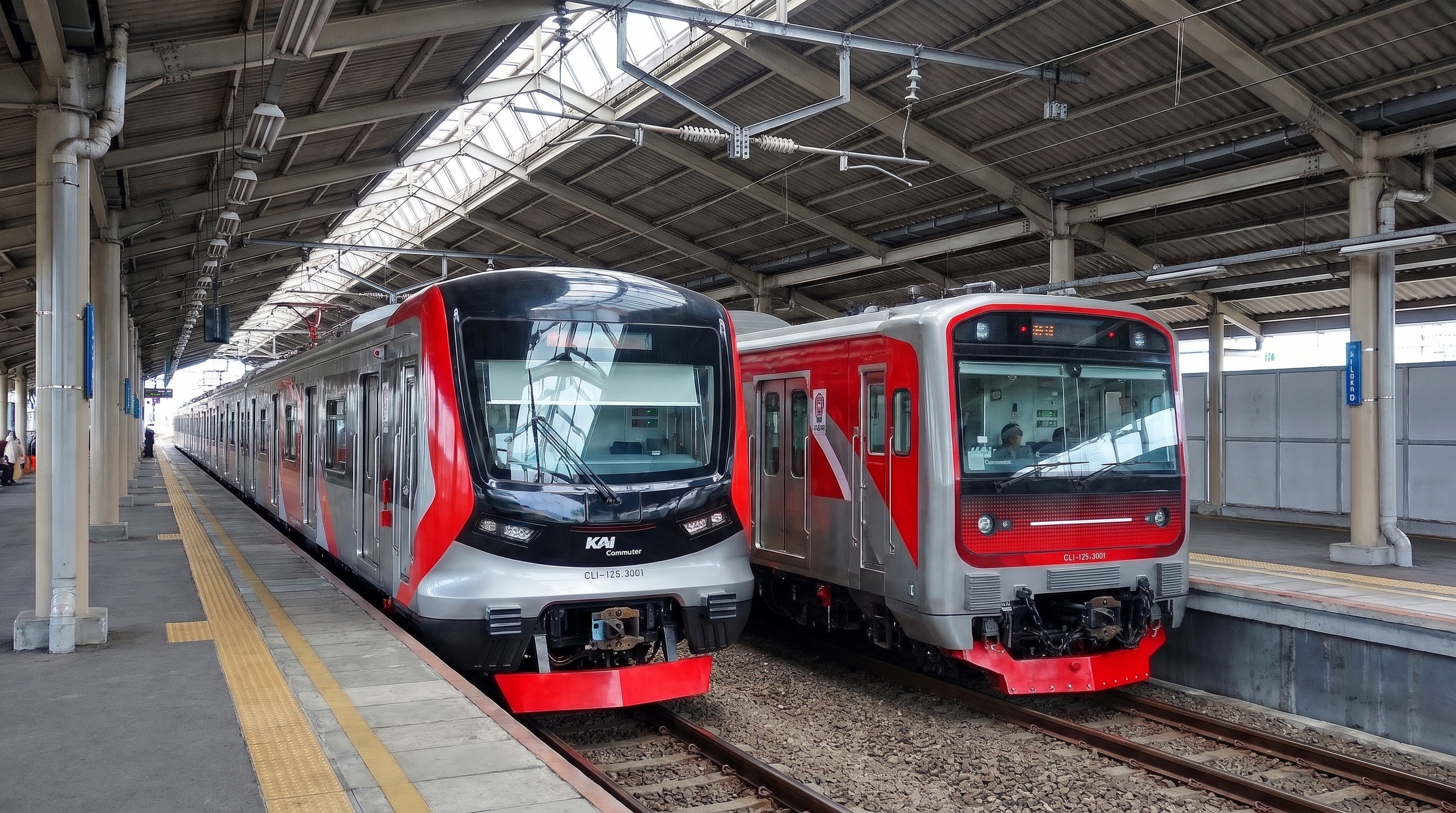
- Full Commercial Deployment: As of November 2026, all 11 CRRC-built SFC120-V series (CLI-125) trainsets are in flawless daily commercial service across the high-density Bogor and Cikarang lines.
CRRC Sifang's decisive competitive edge lies in its engineering flexibility to customize carbody specifications to Indonesian infrastructure survey data. This includes high-capacity HVAC units optimized for equatorial heat, platform clearance profiling, and comprehensive transfer-of-knowledge agreements covering depot-level maintenance.
3. Japan: J-TREC, Toyo Denki Seizo, and Nabtesco
While Indonesia has cancelled the procurement of used Japanese trains and bypassed whole-car imports from Japan in 2024, the Japanese rail industry remains the technological backbone of Indonesia's domestic commuter manufacturing.
In engineering the iE305 series, PT INKA collaborated directly with the Japan Transport Engineering Company (J-TREC) for stainless steel carbody structural design, while key traction and electrical subsystems were procured from premier Japanese vendors:
- Traction & Propulsion Systems: VVVF-IGBT Inverters (type RG6061-A-M) and traction motors manufactured by Toyo Denki Seizo.
- Braking Systems: Integrated regenerative and pneumatic blending brake controls engineered by Nabtesco Corporation.
- Auxiliary Components: Single-arm pantographs (type PT7206-A), master controllers, passenger information displays (PIDS), and electric door drive mechanisms.
Regarding commercial pricing, J-TREC initially offered new commuter cars at approximately IDR 18.8 billion per unit (IDR 225.6 billion per 12-car set) in early 2023, nominally undercutting INKA's baseline. However, in October 2023, the Japanese consortium revised its proposal by escalating pricing above Chinese bids while altering technical and financing conditions, leading KAI Commuter to award the 2024 new-train import tender to CRRC Sifang.
4. South Korea: Woojin Industrial Systems & Dawonsys
Two prominent South Korean rolling stock manufacturers, Woojin Industrial Systems Co., Ltd. and Dawonsys Co., Ltd., participated actively in KCI's international procurement tenders during 2023–2024, as documented in state audit reports.
While neither Korean vendor secured contracts due to higher pricing structures relative to CRRC and less tailored technical adaptations for local track conditions, both firms maintain technical pre-qualification status. Consequently, Woojin and Dawonsys represent viable alternative consortium partners should PT INKA seek to diversify joint-assembly supply lines for the 23-trainset program.
4. Detailed Technical Specifications & Rolling Stock Engineering
All commuter rolling stock deployed across the Greater Jakarta network must comply rigorously with Ministry of Transportation Regulation PM 175 of 2015 (Technical Standards for Self-Propelled Normal Speed Rolling Stock) and PM 49 of 2023 (Airworthiness Certification requiring 4,000 km of unladen dynamic testing for prototypes and 2,000 km for serial production units).
Technical Review of iE305 Incidents & the September–October 2026 Recall
The introduction of the indigenously built iE305 series (CLI-225) traversed a demanding testing and remediation phase in September 2026. On 4 September 2026, Trainset 4 experienced a low-speed derailment while negotiating the platform turnout for Track 9 at Jakarta Kota Station. Joint investigations by KAI, KCI, and INKA revealed that secondary suspension spring stiffness characteristics required recalibration for ultra-tight radius urban turnouts.
Simultaneously, comprehensive inspections revealed micro-fractures in structural underframe members on several operational sets. These components originated from local component batches introduced under the 40% domestic content (TKDN) program.
Classifying these structural findings as non-negotiable safety critical items (no-go items), KAI management instituted a precautionary fleet recall for all 7 active trainsets between 7 and 30 September 2026. At the Depok Depot and Manggarai Workshop, technical teams executed rigorous rectifications:
- Protective Coating Removal: Complete stripping of protective coatings across underframes to bare metal.
- 100% Non-Destructive Testing (NDT): Comprehensive ultrasonic and magnetic particle testing across every welded gusset and joint.
- Structural Reinforcement & Component Replacement: Replacement of substandard fittings with high-tensile materials alongside bogie spring recalibrations.
- Overload Commissioning: Static and dynamic proof load testing exceeding nominal full capacity before certification release.
By 6 October 2026, all seven trainsets successfully completed General Check-Ups (GCU) and re-entered passenger service. Subsequently, Trainset 8—incorporating revised internal coding (CLI-226)—successfully concluded its 4,000 km dynamic reliability trial on the Bogor–Jakarta Kota corridor from 4 to 6 November 2026 without operational anomalies.
5. Consist Formation Strategy: Balancing 7 SF-12 and 16 SF-8 Trainsets
A distinctive operational facet of the 23 additional trainsets is their bifurcated formation strategy. While prior contracts for 27 sets (16 INKA + 11 CRRC) were uniformly ordered as fixed 12-car formations (SF-12), the 23-set procurement is structured as:
- 7 Trainsets in 12-Car Formation (SF-12): Totalling 84 railcars (30.4% of total order).
- 16 Trainsets in 8-Car Formation (SF-8): Totalling 128 railcars (69.6% of total order).
Physical Platform Constraints on Secondary Corridors
This deliberate operational split addresses tangible infrastructure bottlenecks at secondary stations. Addressing Commission VI of the DPR, KAI President Director Bobby Rasyidin highlighted the Tanjung Priok–Jakarta Kota loop line (via Ancol and Kampung Bandan):
“On secondary corridors such as Tanjung Priok to Jakarta Kota, physical platform lengths at several heritage stations cannot be extended due to dense urban encroachment and immovable civil structures. Operating 12-car formations on these routes leaves multiple cars overhanging beyond platform edges, introducing severe passenger safety hazards during boarding and alighting. Deploying 16 dedicated 8-car trainsets ensures operating safety while maintaining frequent service intervals.”
Operationally, 8-car formations offer enhanced electrical efficiency during off-peak hours and enable faster turnaround times at terminal stations equipped with compact turnouts.
6. Manufacturing Bottlenecks, Supply Chains, & Syndicated Financing
Fulfilling the 23-trainset mandate within 2 to 3 years (2028–2029) requires synchronized financial engineering and industrial scaling. The paramount hurdle resides in domestic manufacturing capacity.
INKA Assembly Capacity & Delivery Risk Mitigation
Delays in delivering 9 of INKA's initial 16 trainsets by more than a year demonstrated that actual assembly output at the Madiun plant averaged 2 to 3 trainsets annually, against an initial theoretical target of 8 sets. Bottlenecks stemmed from component procurement lead times for foreign traction systems and the learning curve of local Tier-2 suppliers.
To deliver the 23 new trainsets alongside the 8 remaining units of the legacy contract (31 trainsets total), PT INKA and KAI are deploying a tripartite strategy:
- Full Operationalization of Banyuwangi Plant: Dedicating the expansive Banyuwangi facility to stainless steel carbody fabrication and final EMU assembly, while reserving Madiun for bogie construction and non-electric passenger coaches.
- International Co-Production Alliances: Authorizing INKA to partner with global builders (such as CRRC Sifang) via Semi-Knocked Down (SKD) or Completely Knocked Down (CKD) arrangements, ensuring final assembly, systems integration, and quality assurance take place on domestic soil.
- Interim Operational Bridge (2026–2027): Completing 2 refurbished 12-car trainsets at INKA to extend asset lifespans by up to a decade, backed by intensive depot preventive maintenance cycles at Depok and Bukit Duri to maintain aging trains in revenue service.
Financing Architecture and Capital Allocation
The capital expenditure framework for Greater Jakarta commuter procurement builds upon the established financing model of the previous 27-trainset program (IDR 9.18 trillion):
- State Equity Participation (PMN): Constituting 58% to 60% (IDR 5.3 trillion) of total funding, strictly dedicated to domestic orders placed with PT INKA. Under this facility, KAI transferred IDR 744.46 billion to INKA in May 2026, with the remaining IDR 1.05 trillion released progressively against verified construction milestones.
- Syndicated Commercial Banking Facilities: Accounting for approximately 40% (IDR 3.60 to 3.69 trillion), syndicated across national state-owned banks to finance direct train imports (CBU) from CRRC Sifang.
- Internal Corporate Cash: Covering the remaining IDR 190 billion for dynamic certification trials, regulatory fees, and overseas shipping logistics.
For the 23 newly mandated trainsets, an identical capital structure will be deployed, combining Danantara state equity injections with syndicated commercial bank loans structured against guaranteed Public Service Obligation (PSO) compensation tariffs.
7. Frequently Asked Questions: New Commuter Rolling Stock Procurement (FAQ)
Conclusion & Strategic Outlook
The government's decisive cancellation of used train imports in favor of 23 brand-new trainsets represents an ambitious leap toward domestic railway manufacturing sovereignty. While requiring rigorous operational discipline to bridge fleet capacity gaps between 2026 and 2028, executing INKA's flexible production scheme alongside top-tier global partners ensures that Greater Jakarta's commuter network will enter an era of world-class reliability, advanced efficiency, and pride for millions of daily passengers.