1. Strategic Imperative: Why Safe Spaces for Female Passengers Are an Absolute Priority
Mass railway transit represents a social microcosm. Within a train carriage traveling hundreds of kilometers through the night, hundreds of strangers share confined compartments for extended hours. For many passengers, this journey offers rest en route to their destination. However, for women, long-distance travel has historically involved acute psychological anxiety regarding personal safety and vulnerability to unwanted verbal and physical harassment.
The PT KAI 2025 Sustainability Report (Pages 346–352) squarely embeds passenger protection within the mandatory framework of UN Sustainable Development Goal 5 (Gender Equality). This strategic stance is supported by alarming empirical data from the 2022 survey conducted by the Coalition for Safe Public Spaces (KRPA), which revealed that nearly half (46.8%) of women in Indonesia have encountered sexual harassment in public transit systems.
These incidents range from intrusive staring and deliberate physical contact while passengers are asleep to verbal catcalling and non-consensual photography. Prior to the digital evolution of Access by KAI, female solo travelers had to select coach seats blindly on generic application layouts without knowing who would occupy neighboring seats. On long-haul journeys—whether Executive Class in a 2-2 configuration or Economy Class in 3-2 or 2-2 layouts—being seated beside an unfamiliar male passenger overnight frequently triggered unease and perpetual vigilance.
Technical Logic Architecture: Female Seat Map in Access by KAI
National ID validation pipeline, dynamic real-time seat rendering, and end-to-end privacy encryption.
2. Technical Architecture: How the Female Seat Map Protects Privacy and Security
A primary design challenge addressed during system development was avoiding a scenario where highlighting female passengers could inadvertently expose them to targeted stalking or harassment. KAI's digital development unit and cybersecurity consultants formulated a multi-tiered encryption and visualization architecture to eliminate this vulnerability:
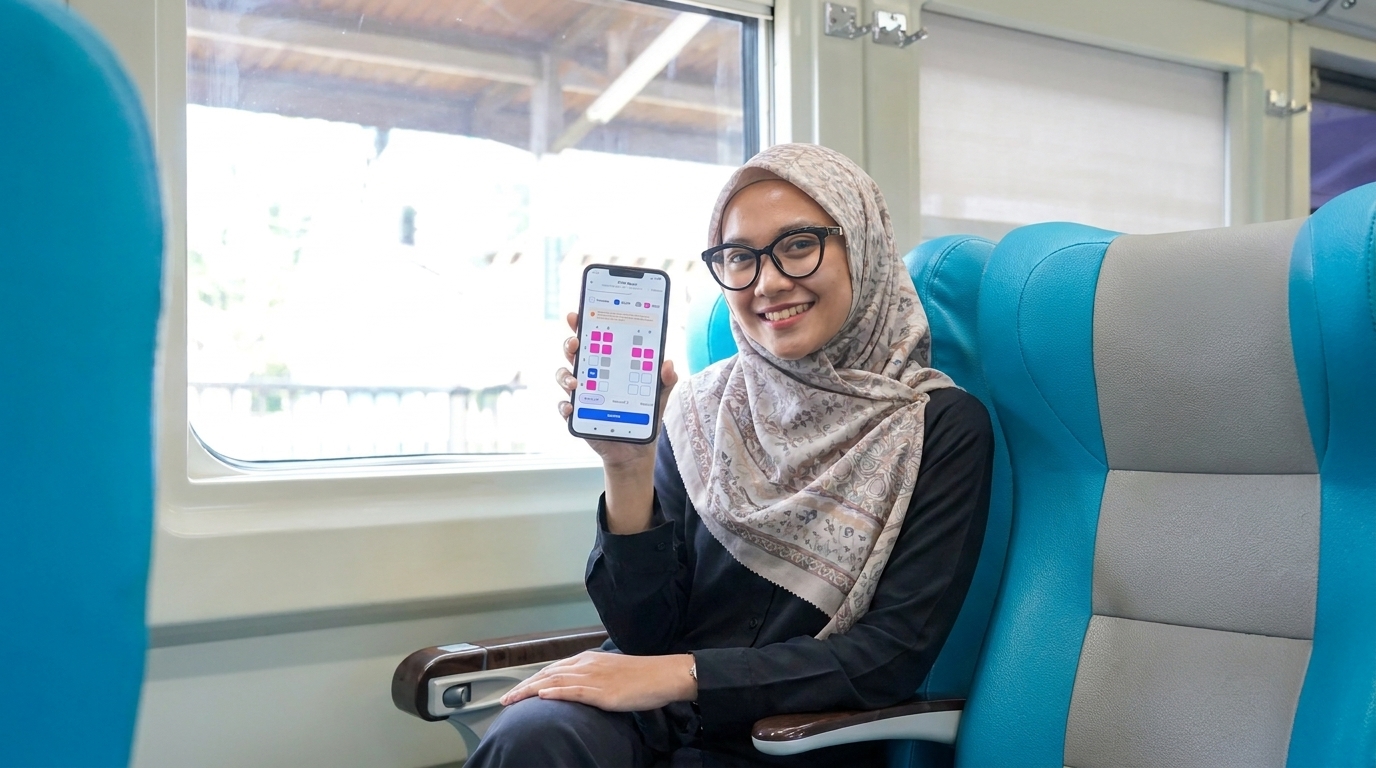
- Absolute Data Anonymization: In the Access by KAI booking interface, occupied female seats display solely as a pink visual indicator. No names, initials, ages, phone numbers, or biographical data are exposed. To third parties, the seat is simply flagged as booked by a female commuter.
- Direct Civil Registry (NIK) Verification: Indicator assignment cannot be manipulated by user profile selections. Instead, gender parameters are verified directly against official National Identity Records (NIK) during user authentication with the Ministry of Home Affairs database.
- Empowering Female Companion Seating: Solo female travelers can deliberately select seats adjacent to fellow female passengers already marked in pink, securing immediate peace of mind for overnight journeys.
- Seamless Family and Group Travel: Male passengers traveling with family members, spouses, or daughters retain complete liberty to book adjacent seats without arbitrary operational restrictions.
3. The Comprehensive Multi-Layer Safety Ecosystem: From AI Cameras to Lifetime Blacklists
The Female Seat Map operates as the digital frontline at booking. True passenger safety requires an unbroken chain of operational enforcement throughout the travel lifecycle. The 2025 Sustainability Report details three complementary defensive tiers:
| Security Layer | Technology / Procedure | Operational Reach | Protection Impact |
|---|---|---|---|
| Pre-Trip (Booking) | Dynamic Female Seat Map in Access by KAI v6.9.11 | 100% Commercial Intercity Trains (Executive, Business, Economy) | Grants solo female travelers autonomy to choose adjacent female company. |
| Station (Boarding) | Face Recognition Gates linked to National Offender Registry | 19 Major Terminal Hubs (Gambir, Senen, Bandung, Yogyakarta, Surabaya, etc.) | Blocks blacklisted sexual offenders from boarding any train across Indonesia. |
| Onboard (In-Transit) | Active Polsuska Security Patrols, Dedicated Conductors & Cabin CCTV | 100% Active KAI Group Rolling Stock | Emergency intervention response under 3 minutes upon reporting via conductor hotlines. |
| Post-Incident (Legal) | Permanent Lifetime National ID Ban & Handover to State Police | Universal Legal Enforcement Across All Operating Divisions | Absolute deterrent: offenders permanently forfeit access to rail transit services nationwide. |
4. Global Rail Comparison: How KAI's Model Stands Against International Operators
Protecting women on public transit has prompted distinct solutions internationally, but KAI's hybrid architecture addresses unique logistical needs:
- Japan (JR Group / Tokyo Metro): Operates morning peak-hour Women-Only Cars. While highly effective at curbing rush-hour chikan offenses on commuter loops, it cannot be applied to reserved-seat long-haul services like the Shinkansen.
- France (SNCF): Relies on armed SUGE transit police units, app-integrated emergency buttons, and nationwide SMS/call shortcode 3117 for real-time reporting on TGV and TER networks.
- Indonesia (KAI Group): Deploys a hybrid multi-modal strategy. For urban commuter rail (KRL Jabodetabek), KAI maintains dedicated physical cars at train extremities. For long-distance intercity fleets, KAI pioneers an integrated digital Female Seat Map that empowers choice without rigid physical car segregation.
5. Emergency Standard Operating Procedures: Clear Action Guidelines for Passengers
KAI enforces clear, non-negotiable protocols to ensure reporting sexual harassment on board is immediate, safe, and confidential:
- Direct Contact with On-Duty Conductor: Conductor names and direct mobile phone numbers are prominently displayed on coach partition walls. Passengers can call or text via WhatsApp discreetly.
- Notify Polsuska Officers or Cabin Crew: Uniformed Polsuska personnel patrol coaches every 30 to 45 minutes. Discreet signals or private verbal notifications trigger immediate support.
- Securing and Detaining the Alleged Offender: Polsuska officers escort the accused individual to a secure staff compartment or dining car, preventing further escalation and protecting the victim from intimidation.
- Eviction at the Next Scheduled Stop: The suspect is offboarded at the nearest station with railway police facilities for formal investigation (BAP) and formal transfer to state law enforcement.
- Victim Support & Legal Care: Dedicated female customer care personnel accompany the passenger throughout the remainder of her trip to provide emotional and logistical support.
Frequently Asked Questions (FAQ)
Can male passengers see the pink indicator seats in the app?
Yes. Male users see the pink indicator signifying that the seat is booked by a female passenger. This provides transparent context, encouraging solo male commuters to select other vacant seats when available.
Does the system prohibit men from booking seats next to pink seats?
No strict restriction is enforced, particularly when carriage occupancy is near capacity or when passengers travel together as family (spouses, fathers, children). The system serves as an informative passenger comfort guide rather than an exclusionary barrier.
How does KAI safeguard the personal data and privacy of female passengers?
Access by KAI adheres to ISO 27001 information security standards. National registry inputs are transmitted over TLS 1.3 encryption with AES-256 storage. Public seat maps only render a boolean gender flag, ensuring no private data is ever sent to client devices.