Forensic Financial Analysis of PT KAI: Whoosh, LRT Jabodebek, and Debt Burdens 2023–2026
A cross-examination of PT Kereta Api Indonesia (Persero)'s 2025 Sustainability Report, Audited Consolidated Financial Statements (2023–2025), H1 2026 Interim Financial Report, 2026 RKAP Corporate Budget, and the investigative audit findings of the Audit Board of the Republic of Indonesia (BPK) uncovers a profound structural financial paradox: KAI's core railway operations are exceptionally profitable and cost-efficient, generating record operating profits of Rp8.39 trillion in 2025 (23.46% operating margin) and Rp4.66 trillion in H1 2026 (25.96% operating margin). Nevertheless, this robust operational resilience was severely cannibalized by below-the-line burdens imposed by government National Strategic Project (PSN) mandates, with 66.04% of 2025 operating profit and an astonishing 98.83% of H1 2026 operating profit completely absorbed by associate losses, debt interest charges, and currency depreciation.
- Primary Trigger #1 – The Whoosh High-Speed Rail Vortex (PT PSBI / KCIC): Consortial losses from the Jakarta–Bandung High-Speed Rail project triggered an associate loss recognition of Rp2.91 trillion in 2025 and surged to Rp2.99 trillion in the first six months of 2026 alone (wiping out 91.2% of H1 2026 potential net profit). KAI's carrying investment value in PSBI collapsed by 92.17% from Rp3.36 trillion (December 2025) to a meager Rp262.79 million by June 2026, while total receivables owed by PSBI to KAI mounted to Rp10.41 trillion (~10% of KAI's total assets) with an impairment allowance of Rp1.55 trillion.
- Primary Trigger #2 – Syndicated Debt Charges & LRT Jabodebek Deficit: Corporate finance charges escalated to Rp2.63 trillion in 2025 and Rp1.38 trillion in H1 2026 (projected to hit Rp3.15 trillion in the 2026 RKAP). The Rp32.5 trillion LRT Jabodebek project posted a net operational cash flow deficit of Rp213.32 million in 2025 under BPK audit scrutiny, compounded by an unpaid construction liability of Rp2.2 trillion owed to contractor PT Adhi Karya (Persero) Tbk and a Track Access Charge (TAC) PNBP payment deferral of Rp1.009 trillion granted by the government.
- Primary Triggers #3 & #4 – Effective Tax Rate Distortion (38.50% ETR) & Foreign Exchange Shock: KAI's Effective Tax Rate spiked to 38.50% in 2025 because Whoosh associate losses are treated as non-deductible expenses under Indonesian tax law. In H1 2026, net foreign exchange losses multiplied over tenfold to -Rp235.47 million due to Rupiah depreciation against the US Dollar and Chinese Renminbi.
- Primary Trigger #5 – Micro Operational Leaks & Climate Disruptions: Commercial revenue shortfalls against 2025 RKAP targets reached -Rp1.475 trillion (passenger shortfall of Rp956.00 million and freight shortfall of Rp519.29 million). A +350% spike in hydrometeorological disruptions (396 incidents) generated Rp34.18 million in measured losses in Daop 4 Semarang and connecting mainlines, accompanied by 205 technical locomotive recalls (Traction Motor and Fuel Transfer Pump issues), 291 level crossing collisions (110 fatalities), and an alarming 62% default rate (Rp7.95 million) in community micro-credit facilities (PUMK).
- 2025 Sustainability Report Audit Discrepancies: The investigation uncovered four critical quantitative anomalies in the 2025 SR: a mathematical summation gap of Rp13.85 trillion in 2024 Economic Value Distributed (EVD), mislabeling of 2025 parent net profit at Rp4.24 trillion (audited figure was Rp2.27 trillion), an erroneous unit label on tax payments (printed as Rp6.98 million instead of Rp6.98 trillion), and an unexplained Rp1.46 trillion freight revenue discrepancy between financial and operational chapters.
1. Anatomy of KAI's Financial Paradox: Core Operating Resilience vs Non-Operating Burdens
A rigorous examination of the consolidated performance of PT Kereta Api Indonesia (Persero) presents a unique case study among state-owned railway enterprises across Southeast Asia. In stark contrast to common public misconceptions that paint the company as an aggregate loss-making institution, official audited financial disclosures confirm that KAI has consistently generated positive consolidated net profits across the entire 2023 to H1 2026 timeline. In Financial Year 2023, net profit attributable to the parent entity stood at Rp1.87 trillion, advancing to Rp2.21 trillion in 2024, and rising further by 2.44% to reach Rp2.27 trillion in 2025 (with total consolidated net profit for the year arriving at Rp2.28 trillion).
At the fundamental operational level—encompassing core train operations, freight haulage, and passenger ticketing—KAI has demonstrated exceptional operational discipline and pricing power. Consolidated operating revenues reached Rp35.11 trillion in 2023, Rp36.11 trillion in 2024, and Rp35.76 trillion in 2025. The minor 0.97% contraction in 2025 revenue was not driven by declining freight demand, but by an accounting boundary shift in fuel procurement for coal haulage agreements with PT Bukit Asam Tbk (PTBA) executed in November 2024. Management compressed the cost of goods sold from Rp23.27 trillion in 2024 to Rp23.02 trillion in 2025, preserving gross profit at an impressive Rp12.74 trillion. Crucially, by streamlining general, administrative, and marketing operating expenses by 16.89% (from Rp5.23 trillion to Rp4.35 trillion), KAI's Operating Profit surged by 10.35% to Rp8.39 trillion, expanding operating margin to an industry-leading 23.46% (compared to 21.05% in 2024 and 11.00% in 2023).
This operational momentum carried directly into the first half of 2026. H1 2026 operating revenue expanded 6.60% year-on-year to Rp17.95 trillion, propelled by robust Eid al-Fitr passenger volumes and heightened coal freight train frequency in Southern Sumatra. Cost of goods sold was held at Rp11.16 trillion, yielding a gross profit of Rp6.79 trillion (+18.80% YoY). With operating overhead disciplined at Rp2.13 trillion, H1 2026 Operating Profit accelerated by 25.79% to Rp4.66 trillion, driving the operating margin up to 25.96%.
However, a catastrophic breakdown occurs immediately below the operating profit line. In FY 2025, out of Rp8.39 trillion in operating profit, Rp5.54 trillion (66.04%) was instantly wiped out by two non-operating line items: KAI's equity share in the net loss of the Whoosh high-speed rail consortium (Rp2.91 trillion) and syndicated loan debt service interest (Rp2.63 trillion). This below-the-line erosion escalated into an acute crisis in the first half of 2026: the combination of Whoosh associate losses (-Rp2.99 trillion), financing expenses (-Rp1.38 trillion), and foreign exchange depreciation losses (-Rp235.47 million) consumed Rp4.61 trillion—equivalent to 98.83% of total operating profit. As a direct consequence, net profit attributable to the parent entity plummeted by 74.12% YoY, leaving only Rp305.37 million (down from Rp1.17 trillion in H1 2025).
The waterfall breakdown below illustrates how KAI's robust operating profitability of Rp8.39 trillion was methodically eroded step-by-step by Whoosh consortial associate losses and syndicated borrowing costs in Financial Year 2025.
2. Primary Trigger #1 – The Financial Vortex of Whoosh High-Speed Rail (KCIC & PT PSBI)
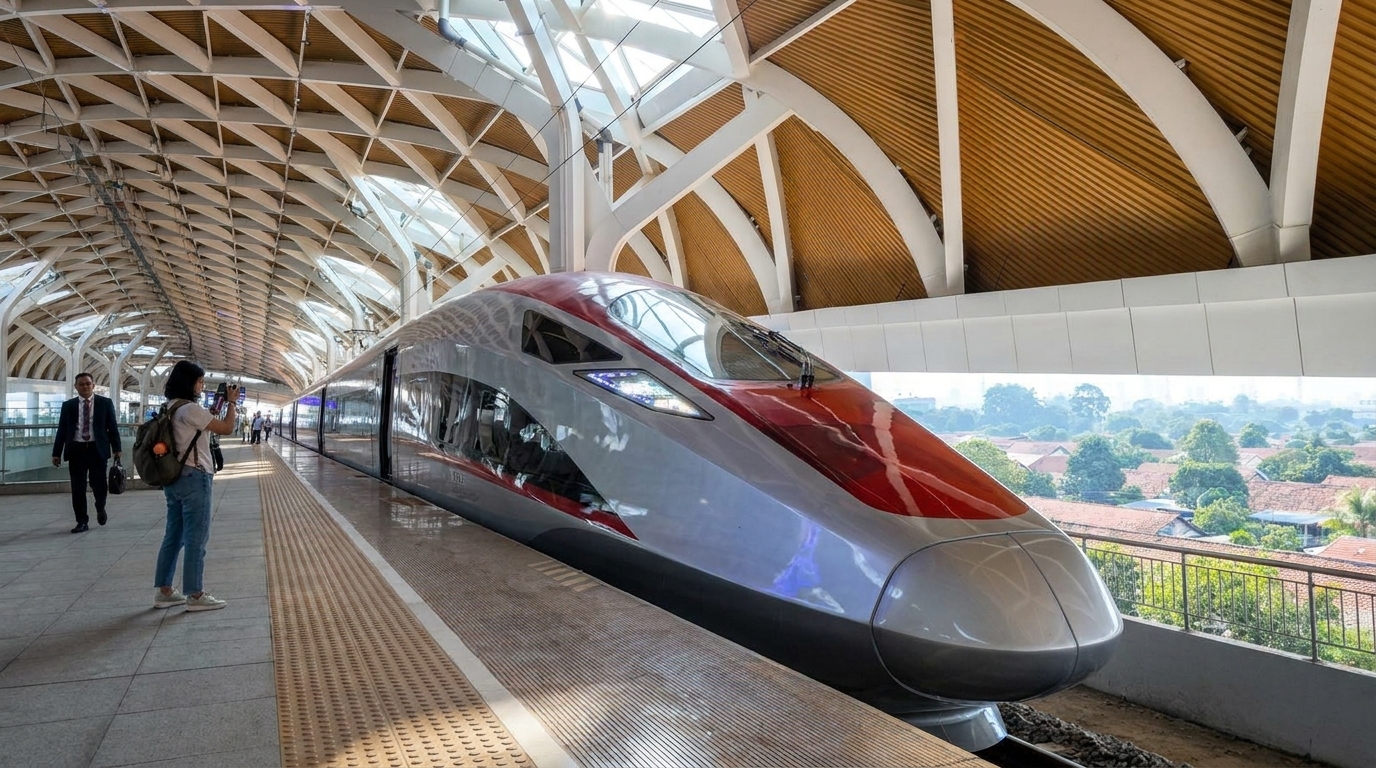
The single most devastating factor siphoning off PT KAI's operational profits is the state-assigned mandate serving as the lead consortium sponsor for the Jakarta–Bandung High-Speed Railway (Whoosh). The project's corporate ownership structure is governed through PT Pilar Sinergi BUMN Indonesia (PSBI), which controls 60% of the joint-venture operating company PT Kereta Cepat Indonesia China (KCIC), while the remaining 40% is held by Chinese railway consortium Beijing Yawan HSR Co. Ltd. Following Presidential Regulation No. 93/2021, KAI was designated as the controlling lead shareholder of PSBI with a 51.37% equity stake, accompanied by PT Wijaya Karya (Persero) Tbk (39.12%), PT Perkebunan Nusantara I (1.21%), and PT Jasa Marga (Persero) Tbk (8.30%).
Construction capital expenditure for Whoosh experienced massive cost overruns, escalating from an initial budget of US$6.07 billion to an audited final total of US$7.27 billion (~IDR 120.68 trillion). To finance the Indonesian consortium's share of the overrun, KAI secured direct sovereign-backed borrowing from the China Development Bank (CDB) totaling US$542.70 million, which was subsequently on-lent to PSBI as Shareholder Loans (SHL). The CDB facility is structured into two tranches: Facility A of US$325.62 million carrying an annual interest rate of 3.2%, and Facility B denominated in Chinese Renminbi (RMB) equivalent to US$217.08 million at 3.1% per annum.
The root structural dilemma of the Whoosh project lies in an acute asset-liability mismatch: annual debt servicing obligations dwarf commercial farebox revenues. KCIC's annual interest burden is estimated at US$120.9 million (approximately IDR 2.0 to 2.12 trillion per year). Conversely, total ticket revenue collected across FY 2024 amounted to only ~IDR 1.5 trillion from 6.06 million passengers. Even with passenger volume steadily growing—recording ~5.1 million passengers between January and October 2026, and cumulative ridership reaching 16.9 million from commercial inception through July 2026—total farebox receipts remain insufficient to cover annual loan interest alone, leaving zero cash flow to amortize principal debt or fund the depreciation of trillions of rupiah in high-speed rolling stock and civil infrastructure.
Consequently, PT PSBI suffered widening consolidated net losses, expanding from IDR 4.19 trillion in 2024 to IDR 4.98 trillion in 2025. This continuous bleeding triggered catastrophic equity erosion: PSBI's net equity collapsed by 64.2% from IDR 14.26 trillion in 2023 to just IDR 5.10 trillion at year-end 2025, elevating PSBI's debt-to-assets ratio to an alarming 79.8%.
Under equity accounting rules, KAI is obligated to absorb PSBI's net losses in direct proportion to its 51.37% ownership. In FY 2024, KAI recognized associate losses of IDR 2.23 trillion. In FY 2025, this burden jumped 30.66% to IDR 2.91 trillion (IDR 2,913.77 billion). The breaking point arrived in H1 2026: in just six months, KAI's absorbed associate losses soared by 215.34% YoY to IDR 2.99 trillion (IDR 2,990.00 billion), annihilating 91.2% of KAI's potential net earnings for the semester.
The resulting balance sheet contagion on KAI has been severe:
- Investment Book Value Collapse: The carrying value of KAI's equity investment in PSBI plunged by 92.17% in six months, falling from IDR 3.36 trillion as of 31 December 2025 to a residual IDR 262.79 million as of 30 June 2026. If unchecked, KAI's investment carrying value will be entirely written down to zero.
- Massive Receivables Exposure: KAI holds total receivables from PSBI amounting to IDR 10.41 trillion (including IDR 9.16 trillion in non-current shareholder loans), representing ~10% of KAI's consolidated asset base (~IDR 105 trillion). In response to PSBI's cash constraints, KAI has already recorded an impairment allowance (CKPN) of IDR 1.55 trillion against these receivables.
To neutralize this balance sheet risk, by November 2026 the Indonesian government initiated a decisive structural intervention: comprehensive due diligence to transfer PSBI/KCIC shareholdings from state-owned enterprises directly to the Ministry of Finance (MoF), targeted for formal execution via Presidential Regulation (Perpres) in December 2026. The inter-ministerial task force unites the Badan Pengelola Investasi Danantara, State-Owned Enterprises Agency (BP BUMN), Ministry of Transportation, BPKP, and the State Attorney (Jamdatun), backed by bilateral negotiations with Beijing to stretch CDB debt tenors out to 60–80 years.
3. Primary Trigger #2 – Syndicated Debt Charges, LRT Jabodebek Operational Deficit, and Adhi Karya Liabilities
The secondary engine of profit erosion stems from exploding finance costs driven by massive syndicated bank borrowing and bond issuances required to finance state-mandated infrastructure capex. KAI's debt interest expenses jumped from IDR 1.51 trillion in 2023 to IDR 2.57 trillion in 2024, advanced to IDR 2.63 trillion in 2025, and absorbed IDR 1.38 trillion in H1 2026. In the 2026 Corporate Budget (RKAP), annual interest expense is projected to establish a new high of IDR 3.15 trillion.
The largest single project burden on KAI's corporate books is the LRT Jabodebek transit network. Total capital expenditure escalated from an initial estimate of IDR 26.7 trillion to IDR 32.5 trillion, financed primarily through commercial bank syndications guaranteed directly by KAI's balance sheet.
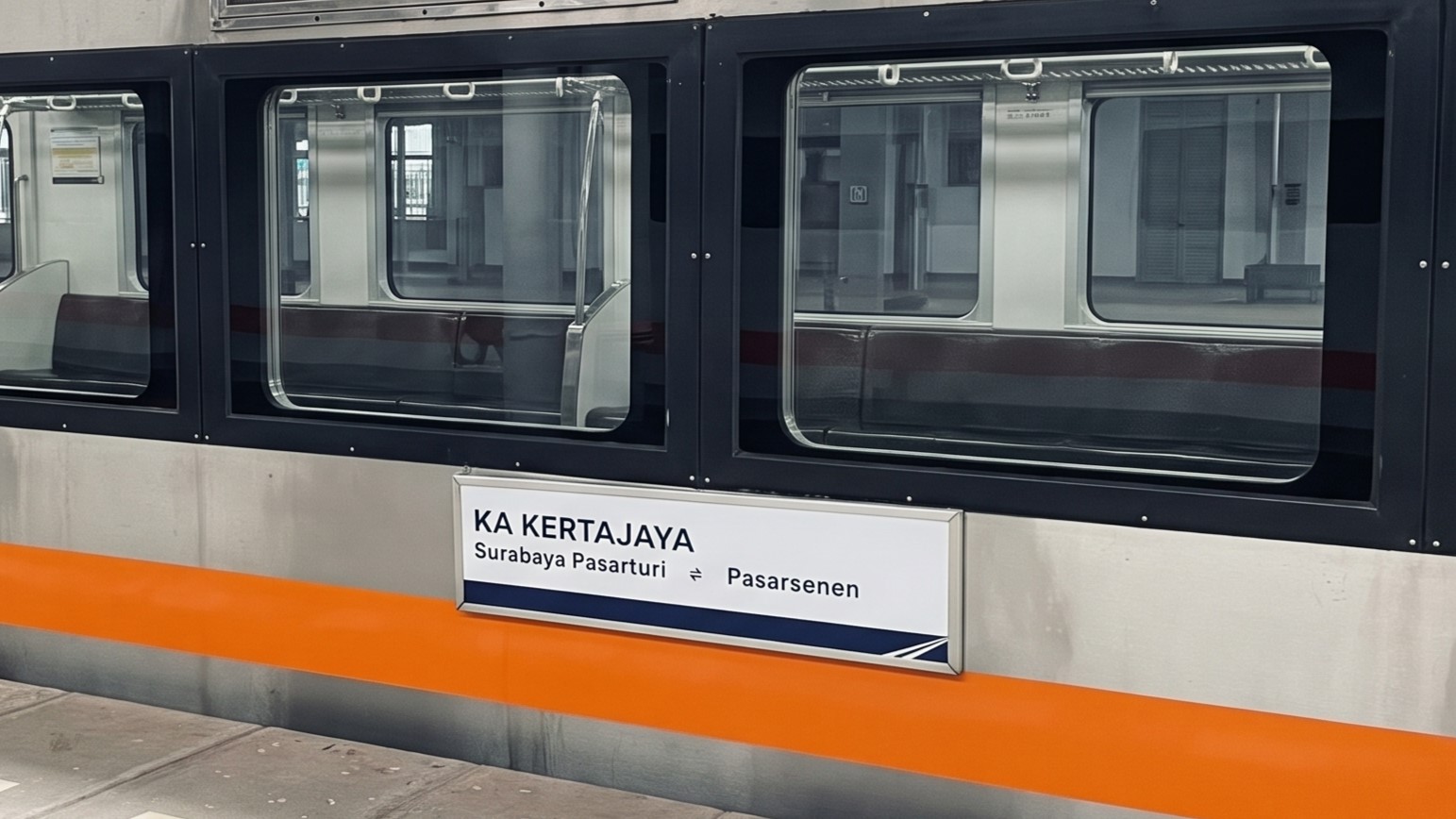
Operationally, LRT Jabodebek has gained substantial commuter adoption: across H1 2025, the system moved 13.04 million passengers, averaging 61,511 daily commuters and exceeding 100,000 on peak days with 452 daily train trips by November 2026. However, farebox revenues remain minimal relative to the project's capital structure: FY 2024 farebox receipts reached only IDR 250.3 billion, with projections of IDR 339.14 billion for 2025 and IDR 372.51 billion in the 2026 RKAP. Despite state PSO fare subsidies of IDR 1.65 trillion in 2024, the division remains far below commercial breakeven.
A forensic audit by the BPK uncovered a stark operational reality: in FY 2025, the LRT Jabodebek Division recorded a net operational cash flow deficit of IDR 213.32 million. This operational cash deficit had to be internally subsidized from cash flows generated by Southern Sumatra coal freight corridors and Java mainline passenger services.
Corporate liquidity was further constricted by two major financial commitments:
- Unpaid Construction Debt to PT Adhi Karya: Outstanding infrastructure construction billing totaling IDR 2.2 trillion remains owed to lead contractor PT Adhi Karya (Persero) Tbk. Formal debt settlement schemes are currently being negotiated alongside the Ministry of Finance and Danantara to prevent inter-SOE solvency disputes.
- Planned Additional LRT Capex: According to the 2025 Sustainability Report (page 120), KAI has allocated an additional IDR 924.62 billion in planned capex for GoA3 automated signaling optimizations and depot infrastructure enhancements.
The acute liquidity strain induced by project debt service was visibly demonstrated when KAI formally requested a deferral of its FY 2025 Track Access Charge (TAC) PNBP payment of IDR 1.33 trillion to the Ministry of Transportation. The government granted a deferral for IDR 1.009 trillion until 14 August 2026, while the remaining IDR 325.11 billion was settled on 14 April 2026 alongside an administrative late penalty of IDR 13 billion.
Credit rating agency PEFINDO reaffirmed KAI's top-tier corporate credit rating at idAAA (Stable), primarily reflecting strong sovereign support. However, PEFINDO issued an explicit caveat: KAI's financial leverage and cash flow protection metrics are now assessed as moderate due to substantial long-term debt liabilities (Total Liabilities in 2025 reached IDR 66.14 trillion with a Debt-to-Equity Ratio / DER of 1.68x).
4. Primary Triggers #3 & #4 – Fiscal Distortion of Effective Tax Rate (38.50% ETR), Pension Liabilities, and FX Turbulences
The third major profit-draining mechanism is the extraordinary surge in KAI's Effective Tax Rate (ETR) to 38.50% in FY 2025. Under standard Indonesian fiscal code, the corporate income tax rate is pegged at 22%. Yet KAI recorded an income tax expense of IDR 1.43 trillion (IDR 1,429.74 billion) against a consolidated Pre-Tax Income (EBT) of only IDR 3.71 trillion (IDR 3,713.78 billion).
This severe fiscal distortion is rooted in Indonesian tax jurisprudence (UU PPh / UU HPP Article 4 paragraph 3 letter f). KAI's equity share in the net loss of associate PT PSBI (IDR 2.91 trillion) is treated by the tax authority as a fiscally non-deductible expense. Consequently, corporate income tax liabilities are calculated purely on KAI's lucrative core operating profits exceeding IDR 6.6 trillion, completely disregarding the multi-trillion Whoosh associate loss. This dynamic created an artificial fiscal wedge, forcing substantial real cash tax outflows that suppressed consolidated net profit to IDR 2.28 trillion and depressed Return on Equity (ROE).
Regarding long-term employee benefit liabilities, KAI's Total Comprehensive Income in 2025 contracted by 10.39% (declining from IDR 2.42 trillion in 2024 to IDR 2.17 trillion). This drop was amplified by recognizing an actuarial post-employment pension loss of IDR 116.34 million. On KAI's balance sheet, total defined employee benefit obligations stand at a formidable IDR 5.74 trillion, representing long-term structural commitments to tens of thousands of active and retired railway personnel.
The fourth trigger is the sharp reversal in foreign exchange fluctuations. In 2024 and 2025, KAI booked net foreign exchange gains of +IDR 179.50 billion and +IDR 178.12 billion, respectively. However, during the first half of 2026, severe depreciation of the Rupiah against the US Dollar and Chinese Renminbi triggered net foreign exchange losses of -IDR 235.47 million. This loss represents a more than tenfold escalation compared to H1 2025 (-IDR 23.31 million), highlighting KAI's vulnerability to unhedged foreign currency debt and imported spare parts procurement.
5. Primary Trigger #5 – Micro Operational Leaks, Climate Shocks in Daop 4, and PUMK Micro-Credit NPLs
Beyond macro project mandates, forensic analysis of field operations reveals micro operational leaks, budgetary shortfalls, and physical climate hazards that cumulatively erode financial margins:
1. Revenue Shortfalls against 2025 RKAP Targets: Commercial revenues in FY 2025 fell short of budgetary benchmarks. Passenger transport generated IDR 12.87 trillion, suffering a shortfall of -IDR 956.00 million against the RKAP target of IDR 13.83 trillion due to post-pandemic mobility normalization and toll road competition across Java. Freight transport generated IDR 12.74 trillion, recording a shortfall of -IDR 519.29 million against the IDR 13.25 trillion target due to temporary coal production quota bottlenecks in Q3 2025. Total commercial revenue shortfall arrived at -IDR 1.475 trillion.
2. Hydrometeorological Disasters & Daop 4 Network Paralysis: Track disruptions caused by extreme weather events surged by +350%, leaping from 88 incidents in 2024 to 396 incidents in 2025. Severe coastal flooding and flash floods across Operational Region 4 (Daop 4) Semarang—triggering cascading cancellations across Daop 1 Jakarta, Daop 3 Cirebon, and Daop 8 Surabaya—caused direct measured losses of IDR 31.39 million. This comprised passenger ticket refunds and delay compensations of IDR 7.07 million, alongside cancelled freight volume of 266,320 tons valued at IDR 24.32 million. Furthermore, emergency track infrastructure restoration (rinja) following floods between Gubug and Karangjati stations added IDR 2.78 million in direct engineering expenses, bringing measured Daop 4 weather damages to IDR 34.18 million.
3. Rolling Stock Technical Recalls & Level Crossing Collisions: KAI logged 205 technical locomotive recalls in 2025, dominated by reliability issues in Traction Motors (TM) and Fuel Transfer Pumps (FTP). On the infrastructure side, 117 track failures required the replacement of 97,450 meters of worn rails. Unregulated level crossings remained a persistent hazard, recording 291 collision incidents and 110 fatalities, generating substantial repair, insurance, and rolling stock downtime costs. The national fuel mandate transition to Biosolar B40 in 2025 and B50 effective 1 July 2026 also necessitated increased fuel filter replacement cycles and injector maintenance.
4. Community Micro-Enterprise Revolving Credit (PUMK) Default Crisis: The Micro and Small Enterprise Financing Program (PUMK) managed under CSR/TJSL suffered an acute default crisis. Out of IDR 12.82 million in active revolving loans, the Non-Performing Loan (NPL) ratio reached 62% (IDR 7.95 million across 345 micro-enterprises). Default concentrations were extreme in Daop 4 Semarang (88% NPL), Daop 8 Surabaya (86% NPL), and Daop 3 Cirebon (67% NPL), exposing significant weaknesses in credit underwriting and collection monitoring.
5. Structural Energy Transition Risk & Underutilized Assets: KAI remains highly reliant on coal freight in Southern Sumatra, which represented 57.52 million tons or 82.7% of total national freight volume (69.57 million tons). This concentration poses long-term decarbonization risks under Indonesia's Net Zero Emissions (NZE) 2060 roadmap. Simultaneously, commercialization of non-transportation assets (station retail real estate, digital advertising, and fiber optic Right-of-Way) currently utilizes less than 10% of potential economic capacity.
6. Forensic Audit of 2025 Sustainability Report Anomalies vs Audited Financial Statements
A meticulous critical audit of PT Kereta Api Indonesia (Persero)'s 2025 Sustainability Report (published in October 2026) reveals significant disclosure gaps and quantitative errors when reconciled against the Audited Consolidated Financial Statements. Notably, the SR document omits the Consolidated Statement of Profit or Loss, entirely shielding the multi-trillion Whoosh associate losses from sustainability scrutiny.
Our forensic review identified four major quantitative and narrative discrepancies:
- 1. Mathematical Summation Gap of IDR 13.85 Trillion in 2024 EVD: In the Economic Value Distributed (EVD) table for FY 2024, total EVD is printed as IDR 14.55 trillion. However, calculating the actual mathematical sum of its five constituent rows (Operating Costs IDR 16.11T + Employee Wages IDR 5.75T + Payments to Capital Providers IDR 2.57T + Tax Payments IDR 3.88T + Community Investments IDR 0.08T) yields IDR 28.39 trillion. This creates an unexplained discrepancy of IDR 13.85 trillion, obscuring the enterprise's true economic footprint.
- 2. Mislabeling of 2025 Net Profit Attributable to Parent: In the 2025 EVD disclosure, the line item "Net Profit Attributable to Parent" is stated as IDR 4.24 trillion. In contrast, the official 2025 Audited Financial Report confirms the net profit attributable to the parent entity was IDR 2.27 trillion (IDR 2,265.87 billion). The IDR 1.97 trillion variance arises because the sustainability reporting metric reflected operating profit prior to deducting Whoosh associate losses and bond interest, presenting an inflated depiction of corporate earnings.
- 3. Typographical Unit Error in Tax Payments (IDR 6.98 Million vs IDR 6.98 Trillion): In the tax payments table on pages 156–157 of the 2025 SR, the table header is erroneously labeled "(In Rupiah)" with a total tax figure of IDR 6,979,620,407 (~IDR 6.98 million). This is an obvious unit misprint; the figures should have been expressed in Thousands of Rupiah, reflecting actual tax contributions of IDR 6.98 trillion (consistent with cash flow statements showing IDR 2.56 trillion in corporate income tax payments alone).
- 4. Inter-Chapter Freight Revenue Discrepancy of IDR 1.46 Trillion: In the financial summary chapters (pages 144 & 148), freight revenue is correctly reported as IDR 12.74 trillion (IDR 12,735.48 billion), matching audited accounts. However, in the freight operations narrative on page 353, freight revenue is cited as IDR 11.28 trillion, generating an unreconciled variance of IDR 1.46 trillion. Additionally, page 353 attributes the entire 57.52 million tons of freight volume to PT Bukit Asam Tbk (PTBA), whereas field operational records establish that PTBA accounted for 40.40 million tons, with private mining concessionaires contributing the remaining ~17.12 million tons.
7. Subsidiary Ecosystem Financial Profile and Balance Sheet Contagion from PT INKA Merger
Amidst the turbulence of national project mandates, KAI's subsidiary ecosystem generated robust commercial performance, delivering reliable dividend streams to the parent entity:
- KAI Services (PT Reska Multi Usaha): Delivered record results in 2025 with revenues climbing 13% to IDR 2.79 trillion and net income advancing 24% to IDR 136.70 billion, driven by digital onboard catering, station parking modernization, and integrated facility management.
- KAI Properti (PT Kereta Api Properti Manajemen): Generated revenues of IDR 1.62 trillion with a net profit of IDR 43.75 billion in 2025. In the 2026 RKAP, KAI Properti targets an aggressive 112.8% surge in net profit to IDR 93.08 billion through Transit-Oriented Development (TOD) commercialization.
- KAI Logistik (KALOG): Posted revenues of IDR 1.10 trillion and net profit of IDR 89.60 billion in 2024, spearheading non-coal container and industrial cargo growth along Java's northern corridor.
- KAI Commuter (PT Kereta Commuter Indonesia): Recorded revenues of IDR 3.40 trillion and net profit of IDR 182.00 billion in 2024. The subsidiary received a State Capital Injection (PMN) of IDR 3.80 trillion in 2025 to fund the procurement and retrofitting of 37 new EMU trainsets for the Greater Jakarta network.
- KAI Bandara & KAI Wisata: Maintained profitable operational recovery across airport links in Jakarta and Medan, accompanied by surging demand for luxury charter and panoramic tourist trains.
Balance Sheet Contagion Risk from PT INKA Merger: While KAI's existing subsidiaries remain profitable, an emerging solvency threat arises from the state's plan to consolidate rolling stock manufacturer PT Industri Kereta Api (Persero) (PT INKA) into PT KAI prior to 2027. The proposed restructuring intends to integrate INKA's manufacturing plants in Madiun and Banyuwangi with KAI's major Balai Yasa maintenance depots across Java and Sumatra.
However, PT INKA is currently ensnared in severe financial distress, burdened by total debt liabilities of approximately IDR 4.7 trillion. On 6 November 2026, credit rating agency PEFINDO downgraded PT INKA's rating to "idB" with a Negative Outlook, signaling substantial default risk on maturing obligations. Merging INKA directly into KAI without strict debt ring-fencing or sovereign recapitalization threatens to contaminate KAI's balance sheet, jeopardize its idAAA credit rating, and divert cash flows away from core railway modernization.
8. Three Financial Turnaround Catalysts for 2027: Comprehensive Restructuring in the Danantara Era
To eliminate non-operating earnings erosion and restore KAI's investment capacity, forensic analysis identifies three critical strategic turnaround catalysts heading into 2027 under the superholding architecture of Badan Pengelola Investasi Danantara:
1. Execution of PSBI/KCIC Share Transfer to Ministry of Finance (December 2026): Enacting the Presidential Regulation (Perpres) following the completion of due diligence in December 2026 represents the most crucial catalyst. By transferring high-speed rail consortium ownership directly to the Ministry of Finance, KAI will permanently cease absorbing multi-trillion annual associate losses. This divestment ring-fences KAI's IDR 10.41 trillion receivables, eliminates future impairment provisions, and resolves the fiscal distortion that drove KAI's Effective Tax Rate to 38.50%, returning it to the statutory ~22% level.
2. Structural Settlement of LRT Jabodebek Deficits & Adhi Karya Obligations: The government must formalize an expanded PSO operational compensation mechanism to cover the LRT division's IDR 213.32 million annual cash flow deficit, supported by an expanded national railway PSO allocation of IDR 5.86 trillion in the 2026 State Budget (APBN). Establishing a formal debt settlement facility for the IDR 2.2 trillion Adhi Karya construction liability via sovereign facilities or Danantara asset securitization will relieve KAI's working capital pressures.
3. Strict Debt Ring-Fencing for PT INKA & Accelerated Business Diversification: Merging PT INKA into KAI and the Balai Yasa maintenance network must enforce rigid debt ring-fencing under 99% Danantara holding governance, ensuring INKA's IDR 4.7 trillion liabilities are restructured independently without encumbering KAI's operational cash flows. Simultaneously, KAI must accelerate freight diversification away from exclusive coal dependence toward container, agricultural, and industrial logistics, while scaling non-transportation asset utilization from under 10% toward a target of 30% by 2027.